The spam update week: some ranking drops were real, many of ours were not
If your rank tracker showed pages falling out of Google in the past two weeks, some of them really did. Others never moved. Telling the two apart is the whole job.
A noisy fortnight
Google announced the September 2026 spam update on September 24 and said it would take about two weeks to roll out. The first wave hit over the weekend of September 25–27, and Search Engine Roundtable collected volatility charts from more than a dozen tracking tools, all spiking on the same days. What looked like the final phase came on October 4–6.
That is real volatility: sites gaining and losing positions because Google changed its mind about them. This article is about something else that happened during the same days, and that is easy to mistake for it.
What we saw on the night of October 4
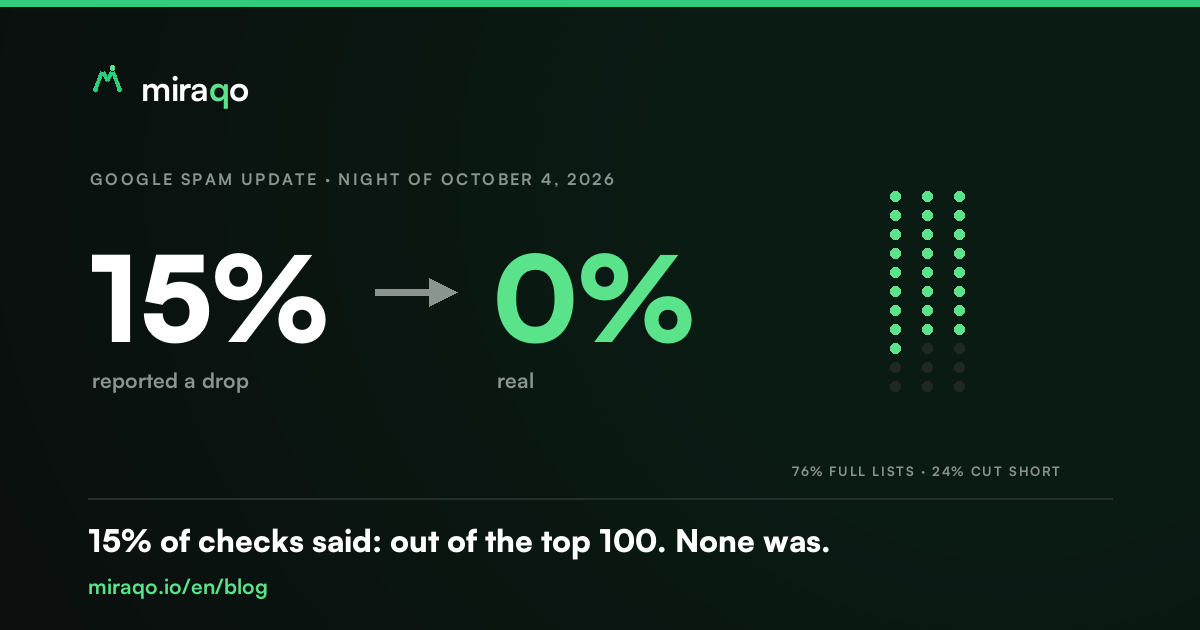
On the morning of October 5, our overnight checks reported a drop out of the top 100 on about 15% of the keywords checked that night. Every one of those sites was online, and in many cases the same keyword, checked on the other device that same night, still found the site. It was not the first sign either: drops of the same kind had been showing up, a few at a time, for some weeks, including on a project checked the day before.
| What the check returned | Share of false drops |
|---|---|
| Full result list (82–100 results), site absent | 76% |
| List cut short, site absent | 24% |
| Total | 100% |
The short lists are the easy case: the result set stopped after a few pages, so "not found" only meant "not found in the part we got". The full lists are the interesting ones. They looked complete, with nearly a hundred results, and the site was simply not there. In about one in six of them the site was cited inside the AI Overview at the top of that same page, while missing from the organic results underneath. On other keywords that night, a full first list without the site was followed, a few minutes later, by a re-check with the site between 2nd and 12th.
Google was serving different pages to different requests, and some of those pages were not the results a person searching from that country would have seen. That night, six first checks in ten had to be repeated, and it was still happening at dawn.
Why a rank tracker falls for it
A ranking check asks one question: where is this domain in this list? If the list is wrong, the answer is wrong, and nothing in a wrong-but-complete list says so. A hundred results without your site look exactly like a hundred results after you really lost the position.
We had already changed the check once, when the first false drops appeared weeks earlier. A keyword that disappeared was checked again straight away, and the second attempt was a deep search that reads all ten result pages instead of stopping early. It caught most of them. It was not enough: the false drops of October 4 are the ones where both checks of the night missed the site. On a night like that, two checks a few minutes apart are not independent. They can be wrong together.
What we changed
So we made a second change. Since this week, a keyword that had a position does not drop out of the rankings on a single night's evidence. The exit is recorded only if the previous day's check also failed to find the site. If yesterday's check found it and tonight's did not, the night is not recorded as an exit, and the keyword is checked again the next night.
One more rule we already had: a check that comes back incomplete never counts as "not in the top 100". Missing data is missing data, not a drop to position 100.
What it costs
The rule has a price, and it is better to say it plainly.
- A real exit shows up one day later. If a page is really deindexed tonight, you see it the morning after tomorrow.
- Two bad nights in a row still get through. If Google serves the wrong page on two consecutive days for the same keyword, the false drop is recorded. The rule makes it much less likely. It does not make it impossible.
We think the trade is right, because a real exit from the top 30 in a single night is rare, while a client who opens the morning report, finds a page gone from the top 100 and spends an hour working out why loses something harder to win back than a day: their trust in every number that comes after it. One day of delay costs less.
What to check in your own data this week
Whatever tool you use, three questions sort the real drops from the noise:
- Did the keyword fall straight from a good position to "not in the top 100", with nothing in between?
- Was it back the next day, at about the same position?
- Does the same keyword on the other device, or in Search Console, show the same drop?
A drop that answers yes, yes, no is very likely a bad check, not a lost ranking. During an update week, those are worth confirming before anyone writes to a client about them.