Which countries and languages Miraqo works in
How to pick a target country and search language for a Miraqo project, why neither is the same as your interface language, and what changes in the data when the market changes.
Every Miraqo project has a default market: a pair made of a target country and a search language. That pair decides which Google we measure by default — a project set to Switzerland + German gets its positions from google.ch in German, not from google.com. Inside the same project, though, you can track individual keywords and individual AI Visibility prompts on other countries: see below.
Three things that are easy to mix up.
- Interface language: what language you read Miraqo in. Set from the top menu, and it never touches the data.
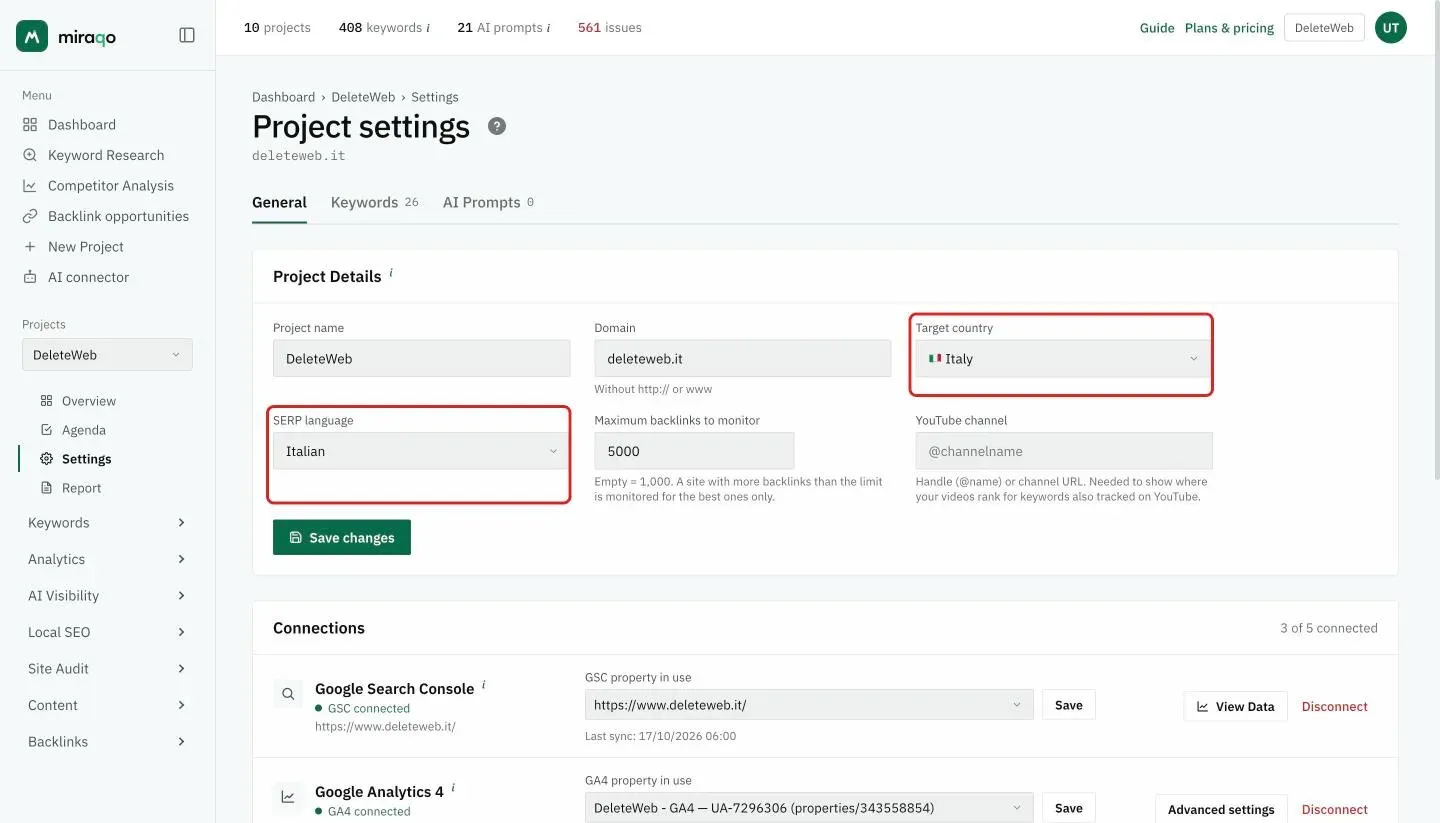
- Target country: which national Google we measure on.
- SERP language: the language of the searches we track in that country.
Where to see the full list
Available countries live in the Target country menu, when you create a project or in its settings. The same list, flags and all, sits at the bottom of the Pricing page — it is generated from the app’s own data, so it is never out of date.
The language follows the country
Once you pick a country, the language menu shows only the languages Google actually serves there. Switzerland gives you German, French and Italian; Poland only Polish; Belgium French, Dutch and German.
That is not a limit we invented. Combinations that do not exist would be accepted by the data providers and come back empty, spending one of your searches for nothing. Better not to let them happen.
So a single-language country shows a single language, and changing the country adjusts the language for you.
What depends on the market
Nearly every number:
- positions for tracked keywords;
- search volumes, difficulty and intent;
- keyword research and keyword gap;
- competitor analysis (Domain Authority, organic keywords, a domain’s estimated traffic);
- AI Visibility: Google’s AI Overview and AI Mode, and the models’ own search, run on the project’s country.
The same domain analysed in different markets returns different numbers, and that is correct: a Polish marketplace measured on google.it is worth crumbs. In competitor analysis the market is printed next to the domain name, so you always know what the numbers refer to.
Several countries in the same project
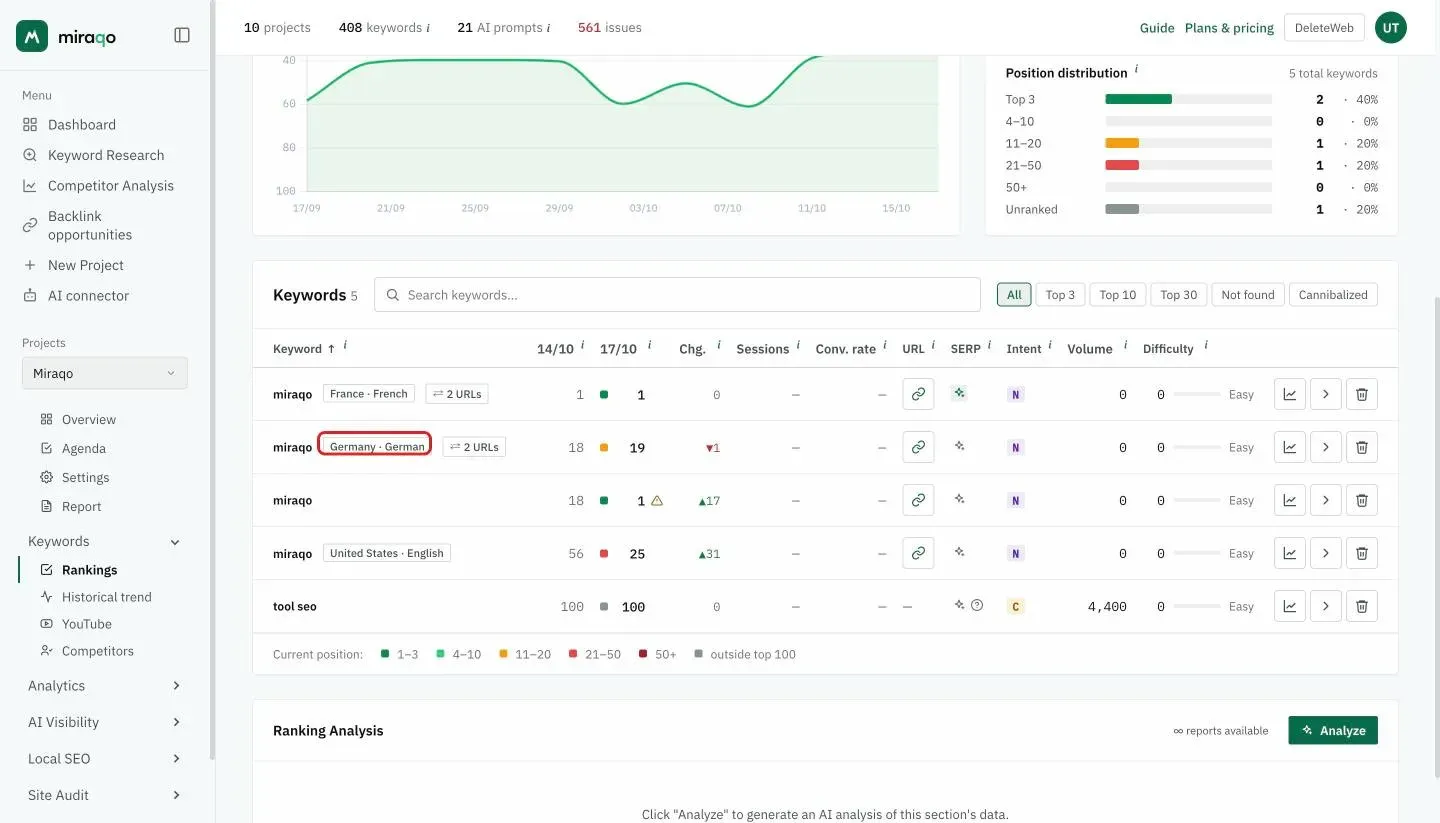
The project market is the default, not a fence. When you add a keyword you pick the country the search is simulated from, and when you add an AI Visibility prompt you pick the country of its web search: the same keyword (or the same prompt) can exist on several countries, each with its own row and its own history.
In the tables, a tag next to the name with the market written out (e.g. “Germany · German”) marks the rows that are not on the project market: no tag means the default market.
One project per language in bilingual countries
In Switzerland, Belgium or Canada you may need the same keyword tracked in two languages. Inside a single project that is not possible: the same word in the same country is one row.
The answer is one project per language — say “Client CH – DE” and “Client CH – FR”. Reports and charts stay separate too, which is usually what you want anyway when you sit down with the client.
Common questions
Can I change the country of a project that is already running? Yes, from the project settings. The history you have collected stays, but it was measured on the previous market: if you switch, consider a new project instead, so the charts remain comparable.
My country is not on the list. Write to us. The list comes from the countries our data providers cover and it grows over time — knowing which ones you are asking for is how we prioritise.
Does the interface exist in my client’s language? The interface is translated into Italian, English, German, French and Spanish. The markets you can track are far more numerous: you can run a project in Japan with the interface in Italian. They are independent.
Last updated: 18 October 2026